Two Weeks or Five Months
Unionized nurses had 11 days to vaccinate or lose jobs. Private-practice professionals got months—and the mandate never applied to them. This timeline undermines any claim of patient safety.

BC Healthcare Workers & Political Discrimination Series
← Success Is Compliance | Post 5 of 12 | Fauci’s Diary vs. Bonnie Henry’s Vaccine Mandate →
On October 14, 2021, Dr. Bonnie Henry issued the Public Health Order mandating COVID-19 vaccination for British Columbia’s healthcare workers. The compliance deadline was October 25, 2021 (Provincial Health Officer, 2021). That is eleven calendar days.
For a nurse who had not yet begun the vaccine series, eleven days was not enough time to complete even a first dose under the National Advisory Committee on Immunization’s own recommended protocols — let alone to achieve the immunological effect the vaccine is designed to produce (National Advisory Committee on Immunization, 2021). The deadline, in other words, could not have been calibrated to protect patients, because no one who started the process on the day the order was signed could have been meaningfully protected by the day it took effect. The timeline only makes sense if its purpose was something other than immunity.
The NACI Problem
The immunological arithmetic is worth spelling out, because it exposes what the eleven-day deadline was actually measuring. NACI’s guidelines recommended an optimal interval of eight weeks between the first and second doses, with a minimum interval of 19 days for Pfizer or 21 days for Moderna, plus a further 14-day waiting period after the second dose for full immunological effect (National Advisory Committee on Immunization, 2021).
Put those numbers together and the conclusion is inescapable. A healthcare worker beginning vaccination on October 14, 2021 could not be fully protected — by NACI’s own standards — until, at the very earliest, late December 2021. The October 25 deadline therefore served no immunological purpose whatsoever. It served a compliance purpose: demonstrate that you have begun the process, or be removed from the workforce. The deadline measured willingness to obey, not protection against disease.
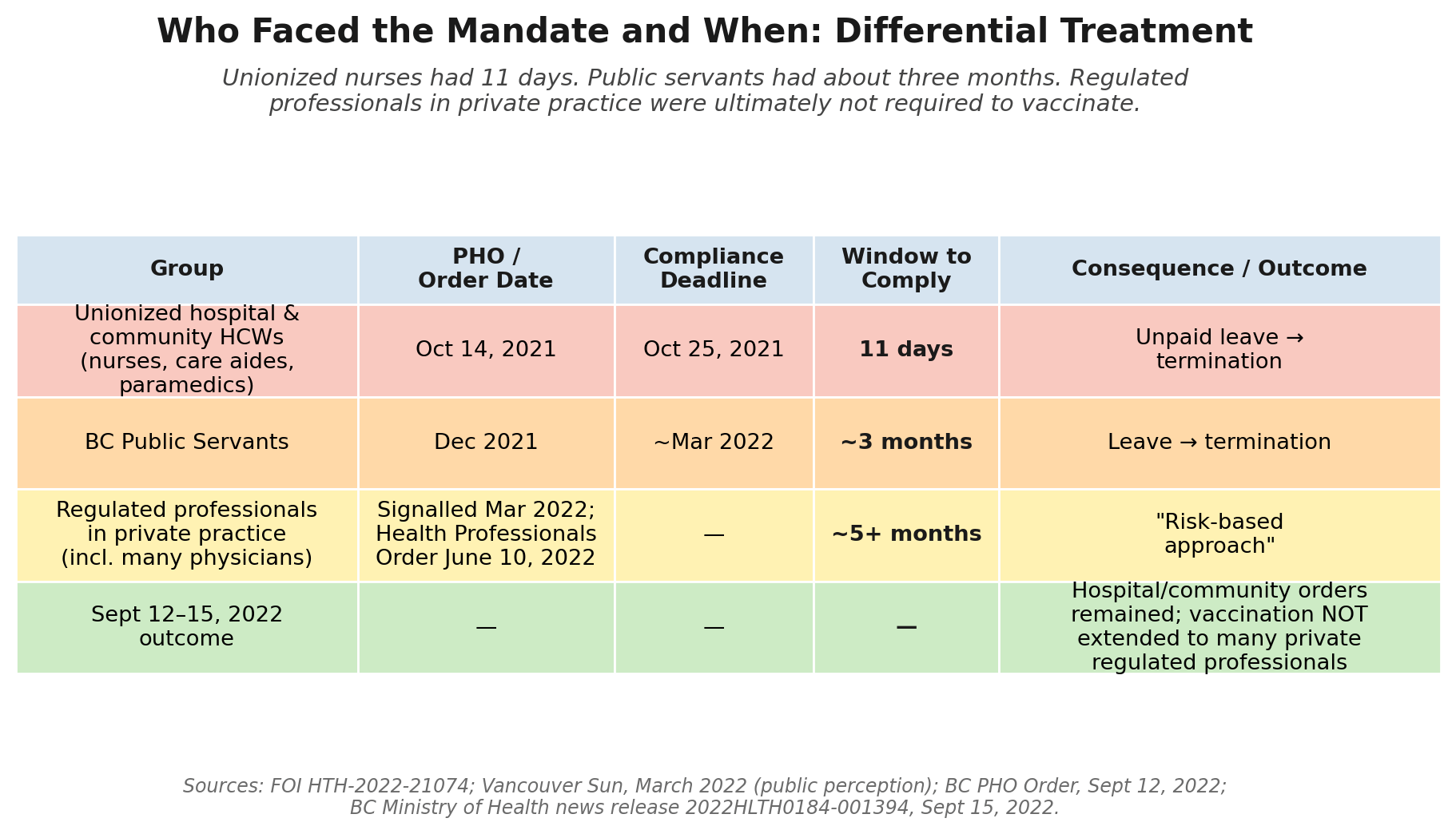
Figure 1: Who Faced the Mandate and When
Sources: FOI HTH-2022-21074; Vancouver Sun, March 2022 (public perception); BC PHO Order, Sept. 12, 2022; BC Ministry of Health news release 2022HLTH0184-001394, Sept. 15, 2022.
The Physician Double Standard
When Dr. Henry’s October 14, 2021 order took effect, its immediate and harshest bite fell on unionized employees of the health-care system — nurses, hospital support staff, paramedics, and others employed through collective agreements. For regulated health professionals, and physicians in particular, the province signalled a different and slower path: Dr. Henry stated that she would pursue a separate, “more nuanced, risk-based approach” for physicians and other regulated health professionals (Vancouver Sun, 2022).
It is worth being precise about who was and was not captured, because the picture is more complicated than a simple carve-out — and precision is what the government’s own defenders would demand. There were effectively two groups of physicians. Physicians working within hospitals were, in large part, already reached through the hospital order’s requirements. The group for whom a genuinely separate and more lenient track emerged was regulated health professionals in private practice — a category that includes many privately practising physicians, alongside dentists, naturopaths, and others — who later became the subject of a distinct Health Professionals COVID-19 Vaccination Status Information Order. It was to this second group that the “more nuanced, risk-based approach” was ultimately applied.
The phrase still deserves attention. A “more nuanced, risk-based approach” is precisely what the unionized nurses did not receive. They received eleven days and a binary choice. The regulated professions in private practice — comparable patient contact, the same putative risk the order invoked — were promised nuance, and given time.
The Approach That Followed
That promised approach unfolded slowly. In March 2022 — some five months after unionized nurses had been given eleven days — the province signalled that regulated health professionals would be expected to demonstrate their vaccination status, with a date of March 24, 2022 attached (Vancouver Sun, 2022). But this track was framed from the outset around attestation and “education” rather than mandatory vaccination on pain of immediate termination (Vancouver Sun, 2022). A separate Health Professionals COVID-19 Vaccination Status Information Order followed on June 10, 2022, directed at regulated professionals (Provincial Health Officer, 2022a).
Then, in September 2022, the province clarified where the line would fall — and it is here that the earlier telling of this story needs correcting. On September 12, 2022, Dr. Henry updated the hospital and community vaccination orders (Provincial Health Officer, 2022b), and on September 15, 2022, the Ministry of Health confirmed the result: vaccination requirements for workers in hospitals, community settings, and residential care “remain in place,” while the Provincial Health Officer had “decided not to require private, regulated health professionals to be vaccinated at this time,” citing the state of the pandemic and the high vaccination rates already prevailing in those professions (BC Ministry of Health, 2022a).
The distinction matters, and it should be stated carefully. The mandate was not abandoned. The hospital and community orders — the orders that had cost unionized workers their jobs — remained fully in force. What did not happen was the extension of mandatory vaccination to many privately practising regulated health professionals: that proposed extension was simply not implemented, deferred indefinitely with the words “at this time” (BC Ministry of Health, 2022a).
The contrast could hardly be sharper. A nurse who missed the October 25, 2021 deadline lost her income immediately and, eventually, her job. Regulated professionals in private practice — who did not wish to be vaccinated — were, over the following months, offered attestation and education, and then told they would not be required to vaccinate at all.
“A Double Standard”
The workers themselves named it. The Vancouver Sun reported the story under a headline that stated the matter as the workers saw it: “Hospital workers say double standard at work as doctors not forced to get vaccinated” (Vancouver Sun, 2022). Meena Brisard, secretary-business manager of the Hospital Employees’ Union, used the same phrase — a “It feels like a double standard when high status health professionals are given a pass on the vaccine requirement that applies to 180,000 other health care workers.” (as cited in Vancouver Sun, 2022).
That headline is best read for what it actually is: powerful evidence of contemporaneous public perception among hospital workers, not a legal determination of the precise scope of the orders. What is beyond dispute is how the policy looked and felt to the people living under it. The HEU noted that some 2,500 of its members — cleaners, orderlies, care aides, the workers who keep hospitals running — had lost their jobs under the mandate, and its members perceived that physicians in the same facilities were not being held to the same immediate, job-ending standard (Vancouver Sun, 2022). Whether or not every physician was in fact unvaccinated and still working, the workers’ sense of unequal treatment was well founded in one crucial respect: the harshest, fastest, most consequential version of the policy fell on the unionized workforce, while regulated professionals in private practice would ultimately not be required to vaccinate at all.
One Structural Difference
If patient-contact risk was comparable between unionized nurses and regulated professionals — and for those working at the bedside it was — then something other than risk explains the differential treatment. The most obvious candidate is structural. Nurses, hospital support staff, and paramedics are unionized through collective bargaining. Physicians and other regulated professionals in private practice, in the main, are not.
Recall the history. In 2019, the BC Nurses’ Union had successfully challenged Dr. Henry’s influenza vaccinate-or-mask policy through the very collective bargaining process that gives unions their institutional leverage. And recall Dr. Henry’s own published research, which identifies unions as one of the three “powerbrokers” whose cooperation is necessary for coercive vaccination policies to succeed (Di Castri, Henry B., et al., 2020). The union that had defeated her in 2019 was, on her own framework, a “powerbroker” to be managed.
The differential timeline suggests that the mandate’s urgency was calibrated not by patient-contact risk — which was comparable for bedside nurses and physicians — but by the structural position of the workers affected. The unionized group that had used collective bargaining to defeat coercive vaccination received the swiftest and harshest version of the new order. The largely non-unionized regulated professions in private practice were given time, nuance, and, ultimately, no vaccination requirement at all.
The province’s own published data make that inversion concrete. The FOI records reviewed in Post 2 of this series show that unionized healthcare workers had reached 96% full vaccination by November 2, 2021 — the benchmark against which the mandate’s success was measured (BC Ministry of Health, 2022b, p. 613). On May 10, 2022, the Ministry of Health published COVID-19 vaccination rates for the 20 regulated health professions subject to the Health Professionals Vaccination Status Information Order (BC Ministry of Health, 2022c). The result, as of April 25, 2022, was this: of those 20 professions, only 7 had reached or surpassed the 96% threshold that the unionized workforce had already met — and been mandated for — six months earlier. The remaining 13 professions sat below that mark. Several sat far below it: naturopathic physicians at 69.2%, chiropractors at 78.1%, traditional Chinese medicine practitioners and acupuncturists at 79.0%, massage therapists at 87.9%, and dental technicians at 90.7% (BC Ministry of Health, 2022c). Notably, the BC College of Nurses and Midwives had not yet completed its reporting under the order at the time of publication.
The logic, if patient protection was the guiding principle, would run in the opposite direction. Groups with the lowest vaccination rates — those furthest from herd immunity and closest to patients in some settings — should have faced the earliest and most urgent pressure to comply. Instead, it was the group already at 96%, coerced to near-100%, that lost thousands of workers. The professions below 96%, some dramatically so, were told they would not be required to vaccinate at all. If the standard that justified terminating a union cleaner was “96% fully vaccinated by November 2,” then by that same standard, thirteen regulated professions — including some with substantial patient contact — had not met it, and were rewarded with no requirement. The selection cannot be explained by coverage levels. It can be explained by collective bargaining.
The Warnings That Were Disregarded
The government was not blind to the consequences of what it was doing. FOI documents show that health authorities raised formal concerns about the staffing impacts of the mandate before it was imposed (BC Ministry of Health, 2022b, p. 194). These were not vague misgivings; they were specific, written warnings about staffing shortages and their effect on the quality of patient care. One internal ministry record states:
Although the Ministry will not have a clear picture of the staffing impact until data begins to be reported as per the Vaccination Status Order, HAs [health authorities] have advised that some facilities have very low staff vaccination rates that may be challenging to increase to an acceptable level and which could impact quality of care for residents. Therefore, in addition to an education and outreach campaign, and even reducing admissions, staffing contingency plans are necessary to prepare for the potential staffing shortages resulting from some staff remaining unvaccinated after the deadline. (BC Ministry of Health, 2022b, p. 194)
The same record acknowledges that contingency planning would have to account for shortages in direct-care services specifically: “Contingency planning at the site level needs to take into consideration types of services (i.e., direct care, non-direct care) where shortages exist and provide for appropriate mitigation strategies” (BC Ministry of Health, 2022b, p. 194). And a marginal comment on the same page, attached to redacted content, is blunter still about the prospect of critical understaffing — and, revealingly, about the need to be able to justify the measure:
Both for any site that has reason to believe staffing will be at a critical low level. Possibility system wide if desired however this will impact income for some operators with private beds and therefore we need to have reasonable belief it [is] warranted[]. (BC Ministry of Health, 2022b, p. 194)
These are documented warnings, in the government’s own files, that the mandate risked pushing some facilities to a “critical low level” of staffing and degrading the quality of care for the very residents the policy claimed to protect. They were raised before the deadline — and the order proceeded regardless.
A genuine public health measure would weigh infection prevention against the health system’s capacity to actually deliver care. Removing thousands of experienced workers, during a pandemic, from a province already in the grip of a healthcare staffing crisis, is not a costless act. It has victims among the patients the system is meant to serve. To impose that cost while simultaneously rejecting the mask-and-testing alternative that had served the province for a decade required a justification far more compelling than “public confidence.” No such justification was documented.
The Missing Data, Revisited
As the previous posts established, the BC Government held no records showing that unvaccinated healthcare workers posed a measurable transmission risk to patients (Doak Shirreff Lawyers LLP, 2022, p. 5). The rushed eleven-day timeline for nurses was built on a factual foundation the government itself could not document — the “no records were located” response to the physicians’ FOI request being the clearest proof. This is precisely what Arbitrator James Hayes, in 2015, had called evidence “planted in shallow soil” (Sault Area Hospital and District v. Ontario Nurses’ Association, 2015, para. 340).
Put the pieces together and the shape of the thing emerges. A deadline too short to produce immunity. The swiftest and harshest enforcement reserved for the unionized workforce. A slower, more lenient track for regulated professionals in private practice, ending in no requirement at all. Documented staffing warnings ignored. And, underneath it all, no data establishing the transmission risk the whole edifice claimed to address.
What It Adds Up To
The differential treatment — eleven days for the unionized workforce, a slower and more lenient track for regulated professionals, and ultimately no vaccination requirement at all for many in private practice — is not consistent with a neutral public health measure applied uniformly to those posing the greatest risk to patients. Applied honestly, such a measure would have hit those with equal patient contact first and hardest, or at least equally. Instead, its sharpest edge fell on the unionized workers who had the least power and who had, through their union, previously challenged the very approach the order embodied.
That pattern is consistent with something else: a targeted enforcement action against a specific group, defined by its structural position and its history of resistance rather than by any epidemiological feature. The next post examines what the October 14, 2021 order actually said — and what its Whereas clauses reveal about the true objectives behind it.
References
BC Ministry of Health. (2022a, September 15). COVID-19 vaccination requirements for health-care system workers remain in place [News release]. Government of British Columbia. https://news.gov.bc.ca/releases/2022HLTH0184-001394
BC Ministry of Health. (2022b). Freedom of information request HTH-2022-21074. Government of British Columbia. https://docs.openinfo.gov.bc.ca/Response_Package_HTH-2022-21074.pdf
BC Ministry of Health. (2022c, May 10). Data published on vaccination status of regulated health professions [News release]. Government of British Columbia. https://news.gov.bc.ca/releases/2022HLTH0138-000737
Di Castri, A. M., Halperin, D. M., McPherson, C. M., Nunn, A., Farrar-Muir, H., Kwong, J. C., & Henry, B. (2020). Narrowing the policy gap: Lessons from years 2 and 3 of the British Columbia influenza prevention policy. Human Vaccines & Immunotherapeutics, 16(6), 1354–1363. https://doi.org/10.1080/21645515.2019.1692561
Doak Shirreff Lawyers LLP. (2022, March 2). Letter to the BC Ministry of Justice and Attorney General re: expanding vaccine mandates. https://www.scribd.com/document/886877023/AGBC-Expanding-Vaccine-Mandates-2022-03
National Advisory Committee on Immunization. (2021, October 22). Recommendations on the use of COVID-19 vaccines. Public Health Agency of Canada. https://www.canada.ca/en/public-health/services/immunization/national-advisory-committee-on-immunization-naci/recommendations-use-covid-19-vaccines.html
Provincial Health Officer. (2021, October 14). COVID-19 hospital and community (health care and other services) vaccination status information and preventive measures [Public health order]. Government of British Columbia. https://www2.gov.bc.ca/assets/gov/health/about-bc-s-health-care-system/office-of-the-provincial-health-officer/covid-19/archived-docs/covid-19-hospital-and-community-vaccination-status-information-preventive-measures-oct14.pdf
Provincial Health Officer. (2022a, June 10). Health Professionals COVID-19 Vaccination Status Information [Public health order]. https://www2.gov.bc.ca/assets/gov/health/about-bc-s-health-care-system/office-of-the-provincial-health-officer/covid-19/covid-19-pho-order-health-professionals-vaccination-status.pdf
Provincial Health Officer. (2022b, September 12). Hospital and community (health care and other services) COVID-19 vaccination status information and preventive measures [Public health order]. Province of British Columbia. https://www2.gov.bc.ca/assets/gov/health/about-bc-s-health-care-system/office-of-the-provincial-health-officer/covid-19/covid-19-hospital-and-community-vaccination-status-information-preventive-measures.pdf
Sault Area Hospital and District v. Ontario Nurses’ Association, 2015 CanLII 62106 (ON LA). https://www.canlii.org/en/on/onla/doc/2015/2015canlii62106/2015canlii62106.html
Vancouver Sun. (2022, March). Hospital workers say double standard at work as doctors not forced to get vaccinated. https://vancouversun.com/news/local-news/hospital-workers-say-double-standard-at-work-as-doctors-not-forced-to-get-vaccinated
Bottom line UNION bosses will take care of themselves (some in cash, considerations or prizes) and throw the membership under the bus. Teachers unions are the lowest of these reptiles.
Thank you for continuing this series. I would like to contribute some nuanced commentary.
1) The mandates for non-unionised professionals in hospitals were announced some months before the "last chance" for HEU and other HA employees. Professionals outside hospitals were not then subject, but those working in hospitals were required to submit to injections or forfeit hospital privileges.
2) BC NDP Bill 36 , "The Health Professions Act", corrected the omission. Henceforth any health profession licensee is required to submit to any injection or treatment deemed necessary by his or her professional college or surrender the licence (but, cunningly, the requirement appears to continue for life for any registrant at the time Bill 36 was proclaimed!) Additionally, Bill 36 transforms " regulatory colleges" into creatures nominated by the Minister of Health; previously college board members were elected by registrants with a few appointments of lawyers and social activists by the Minister.
3)As noted, hospital privileges were subject to compliance with and submission of proof of injection with Covid shots. Having cleaned out my locker on Oct, 25, 2021, I was contacted in early November, 2021, by Dr. Bruce Campana, of VIHA administration, and offered the opportunity to regain my privileges by accepting the "one shot only" J&J preparation. He seemed unimpressed or unaware of its reputation when I referred to it as a "clot-shot." Recall that it was subsequently generally withdrawn due to this collateral damage and publicity.
4)Canada, intentionally, or as a consequence of federal incompetence, did not obtain enough Covid shots (and sent PPE to China!) to follow the tested injection sequence for the various experimental shots. it has subsequently been shown that Health Canada did not even understand the composition of the injected materials. This formed a natural experiment, and I recommend Dr. Marian Laderoute's June article, doi.org/10.36922/GTM025370071, for an expert analysis. The chemistry and immunology are a bit deep but the review of post-injection deaths and the reduced mortality in Canada compared to the UK and USA because of delayed supplies and random mixing of shots is important. Dr. Laderoute is a retired Health Canada immunologist and her Substack, <hervk102.substack.com>, does have an easier treatment of the material.
5) Most crucially, it was known for some years before 2020 that there were effective treatments for coronaviruses; the shots were imposed as "military countermeasures" managed by defence entities with public health as implementation instruments. By early 2020 the demographics of Covid-19 risk were evident and protective levels of Vit. D had been described. Ethical physicians who understood this and managed patients with early treatment schemes had almost zero mortality. In India the management of Covid in Uttar Pradesh with early treatment versus the injection programme in Tamil Nadu should have been enough to inform even the least observant medical system. Hospital protocols with remdesvir (previously demonstrated 50% mortality in Ebola trials, a mere 33% death rate with Covid) and intubation were observably toxic. See <c19early.org> for a curated and commented accumulation of research from the start of the plandemic.